
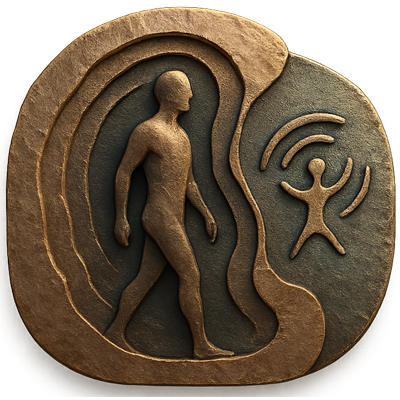
Signals Woven Into Time

Humans turned breath, tools, roads, and light into ever longer threads that bind minds across distance
Murmurs before language
Long before villages marked fields with stone, groups relied on attention shared through small sounds that signaled mood and risk. A soft click gathered foragers without startling birds. A sharp hiss froze feet when a snake wrote a warning across dust. Laughter encouraged exploration by telling the young that a new object was safe to touch. These noises did more than inform. They tuned pulse and posture until a scattered band moved as if a single creature. Over time, mouths learned to sculpt varieties of breath that could name things not present. The hand helped, pointing to tracks and narrowing meaning so listeners guessed right more often than chance. Mothers and fathers repeated patterns to soothe or to scold, while older siblings improvised playful copies that trained memory as a game. Out of these habits rose words that could travel without the item they described. A berry could be requested from a hill away. A storm could be predicted by a description of smells rising on hot air. Syntax arrived as a kindness to listeners. People found that order made recall easier, so subject and action began to walk together in dependable pairs. Tone gathered a second duty beyond emotion, because the rise or drop of pitch could turn statements into questions or turn a request into a rule. Communication therefore evolved from shared attention into layered intention. The mouth learned to carry both map and motive, while the ear learned to judge trust along with truth. In that bargain humanity discovered that meaning thrives where patience and clarity meet.
Gesture rhythm and shared attention
Gesture preceded script and still outlives it in dark rooms and windy fields. A palm held steady with fingers spread can stop a child faster than any word. Two fingers that tap a wrist can ask for time without noise. Hunters choreographed roles with hands and shoulders so a herd could be approached from wise angles. Rhythm joined the toolkit in kitchens and forges where tasks required steady pace. Work songs pressed shared timing into muscle memory, which reduced mistakes while lifting spirits. Drums, rattles, and clapping added volume to range across clearings and river bends, while patterned beats became portable ledgers. Two long pulses and a short one might mean bring water. Three soft taps might mean all safe. Dance grew from these codes, not only as art but also as rehearsal for obedience to pattern. When bodies learn to move together in a circle, minds learn to coordinate without quarrels that waste light. Gesture also stored knowledge of taboo and courtesy. The tilt of a head at a threshold could ask permission to enter a sacred space. The trace of a spiral over a bowl could signal gratitude to those who planted and those who harvested. In markets, signs kept trade honest. A visible count with beans or knots allowed buyers to watch math without paper. In courts, oath gestures raised stakes as witnesses lifted hands toward sky or toward soil. Communication expanded by layering channels, so that sound, shape, tempo, and space joined to keep meaning steady even when wind, fear, or distance tried to shake it apart.
Marks fired into memory
Once portable memory became too heavy for mouths alone, people pressed marks into clay and bark to assist recall. Tallies showed debts and gifts with lines that paired buyers and sellers without need of a third witness. Knotted cords tied story to number, so that livestock and grain moved with their accounting companions. Symbols began as pictures of things, then grew into signs for syllables and ideas when pictures grew confusing. Writing did not replace speech. It changed what speech could reach. Messages could cross winter and mountain if sealed tightly against damp and handed to a careful courier. Law gained sternness from documents that resisted mood. Prayer gained reach from hymns copied for distant choirs who would never meet their authors. Technologies multiplied the gains. Ink widened color and contrast. Bristles and reed nibs widened the range of lines. Fired tablets hardened agreements against accident. Presses in later centuries made reading a public habit instead of a rare craft, and margins became spaces where arguments could bloom without a raised voice. Even errors taught. Scribal slips revealed which letters sounded alike and which words confused a tired reader. Scholars used those slips to refine schools of grammar and to design alphabets that spared future students unnecessary pain. Writing also remade time. Dates and calendars recorded harvests and eclipses, then helped predict taxes and tides. With each improvement, communication moved from urgent breath to durable trace, without losing its intimate aim. A letter still whispered, a note still blushed, and a ledger still carried the scent of labor that filled its columns.
Couriers roads and rumor management
As settlements stretched across valleys and coasts, speed turned into strategy. Paths beaten by sandals hardened into roads that disciplined distance. Waystations appeared with water, fodder, and fresh animals so that news could outrun storm or enemy. Seals protected messages against tampering, while countersigned slips recorded the chain of hands that carried a letter. Diplomatic pouches, locked boxes, and trusted heralds provided layers of safety to fragile truth. Yet roads also carried rumor, which travels faster than carts because rumor requires no load. Communities invented controls that blended ceremony with common sense. Bells announced official dispatches so gossip would pause long enough for facts to be read aloud. Public readings invited questions and provided a witness group against distortions that might follow. Travelers offered affidavits regarding their crossings to establish that routes had remained safe or that bridges had failed. Markets scheduled news hours when strangers swapped reports before prices were set, which tamed panic that otherwise would punish farmers or fishers. Even clothing joined the system. Bright sashes marked authorized couriers, while simple tokens marked runners on foot for villages that maintained relays across hills. In bad seasons, local networks carried hope as well as alerts. Lists of recoverable needs traveled alongside lists of damage, inviting neighbors to aim help where it would matter most. The road and the rumor learned to share a bridle. Communication evolved not only through inventions but also through habits that made trust a public craft. The result was a wider common sense that could be checked, corrected, and carried forward without tears.
Waves wires and the art of compression
Electricity taught messages to ride across copper and air, condensing days into moments. Telegraph code compacted speech into units that snapped from city to city, a new language of dots and dashes that rewarded brevity and punished flourish. Operators became translators who learned to hear shape in tempo and to send empathy along with signal. The telephone replaced code with voices that traveled along lines stretched beside tracks and roads, which allowed negotiation without waiting for a scheduled exchange. Radio, then television, put sound and light into rooms at once, turning the world into a classroom that could laugh and grieve together. These advances demanded compression in a second sense, one that squeezes meaning into limited bandwidth. Headlines learned to carry whole narratives in few words. Advertisers learned seductive brevity. Politicians learned the danger of careless phrases that could now reach every kitchen in an hour. Engineers answered with protocols that balanced noise and clarity, while operators answered with etiquette that limited confusion. The public learned media literacy as a survival skill. Time zones required courtesy about when to call. Party lines required discipline about what to say. Recordings demanded honesty about edits. Each tool brought new mischief and new remedies. Fraud tested wires with false identities. Authentication tested fraud with codes and callbacks. Collapse tested networks with storm or war. Redundancy tested collapse with backup lines and with drills that reminded communities that signal custody is a civic duty.
Screens feeds and identity
Digital channels widened reach while shrinking the cost of a voice. A person with little wealth could speak to millions with a single post, and listeners could answer back from every continent before sunrise. The promise thrilled and stunned. At first, novelty favored speed over care, and forums struggled under waves of mimicry and malice. Gradually, norms emerged that looked familiar to any elder from a village square. Moderation acted as a circle of witnesses. Verified names acted as a form of oath. Rate limits acted as a market rule that prevents one vendor from drowning the street. New genres learned to carry tone without tone of voice. Emojis softened edges the way a smile softens irony. Threaded replies imitated a braid where many hands hold one cord. Searchable archives turned memory into a public garden, yet privacy wilted under careless harvest. People learned to separate public speech from intimate talk again, this time with settings and keys instead of shutters. Identity split into layers. A person could present as teacher, neighbor, fan, and stranger within a single day, each role holding a different contract with its audience. Healthy communities made those contracts explicit. Hurtful communities hid expectations until a misstep made a spectacle. Communication evolved through these trials by pushing toward transparency and consent, just as earlier ages had invented seals, signatures, and common calendars. The old question returned in a bright costume. How do we stay human where words fly faster than consequences arrive. The best answers still sound like patience, courtesy, and repair.
Translation code and common ground
When messages travel farther than faces, translation becomes law and poetry at once. Merchants learned this early and carried phrasebooks that turned measures and weights into cross border trust. Scholars built lexicons that mapped root families across distant tongues, then fed those maps into programs that guess meaning from patterns. Code extended translation beyond language to intent. Protocols let machines exchange messages even when built by rivals, an agreement that resembles treaties about harbors and roads. Universal icons joined the work by offering pictures that spare the need for literacy in a hurry. Yet true common ground does not result from tools alone. Shared standards require humility about home habits that may confuse guests. Cross cultural listening trains the ear to hear where a word carries pride for one group and pain for another. Good translators annotate as they deliver, giving a brief note about why a joke will not land or a proverb will need a cousin to make sense. The reward is more than comprehension. It is friendship and better policy. Emergency messages that ignore language diversity kill. Alerts that arrive in many tongues save and heal. Technology can now transcribe a meeting, translate it, and share it in minutes. That speed encourages inclusivity, but it also tempts laziness. Communities that pair machine help with human review keep respect intact. The long arc of communication bends toward fellowship whenever accuracy and generosity travel as a team.
Signals for crowded centuries
Modern life burdens attention with more invitations than any one mind can honor. Phones pulse while streets glow and inboxes sprout new branches each hour. Evolution responds not only with new gadgets but also with cultural filters that help choose what to hear and when to pause. Status lights and quiet hours serve as social fences that prevent constant knock at the door. Summaries stand in for long documents, and dashboards turn streams into dials that reveal trend rather than trivia. Yet filters can seal bubbles that echo our own voices until we mistake comfort for truth. Communication matures when filters are adjustable and when systems invite periodic exposure to well chosen difference. Good design shows one strong signal at a time and provides a shelf for later reading rather than a flood that punishes restraint. Education matters as much as interface. People can be taught to triage with kindness, to answer first where harm would arise from delay, and to leave no one waiting who lacks power to demand attention. Institutions can publish response promises that balance urgency against care, so public trust remains steady when news is hard. The next century will challenge us to protect thought from noise without starving curiosity. The tools are ancient. Step outside. Breathe. Ask a real question. Listen until the answer ends. Then speak one sentence that helps another person carry the day. Every leap of technology still rewards those humble moves.
What the next message owes the first
From faint warning hiss to fiber light, the arc of communication reveals a constant. People seek to be understood without injury, and they seek to understand without surrender. Every method that endures honors that balance. So the next message owes the first a pledge. Speak with enough clarity that a stranger could help if they wanted to, and listen with enough patience that a friend can change your mind without losing theirs. Use tools that widen reach, then build rooms where voices can slow down. Preserve record without forgetting to gather, because some truths require bodies in a circle and steam from cups to soften sharp edges. Teach children to write as if their reader were brave and kind, and to read as if their writer were tired but honest. Seal private things well, and publish shared things with care for those who will carry the weight. Repair harm when a word flies wrong. Praise those who keep messengers safe. Thank those who build the roads for signals as seriously as those who craft the signal itself. If we keep these promises, our devices will remain servants rather than masters, and our descendants will inherit not only archives of sound and text, but also the grace to use them without breaking one another.